A LETTER TO MIKU

Miku,

I slowed down as if something hit me. Fortunately there were no cars behind and I was able to make a safe U-turn just before the entrance to the freeway. The flight was a little over 2 hours away which would have been the first since the pandemic started.

My siblings and their families were eagerly awaiting to join them for the baptism of my nephew and the birth-day celebration of my niece. I had already packed gifts for all the children so that was not an easy decision but boy I love you so much I felt something was not right…that I couldn’t leave you and your sister the way you reacted…crying and hanging to me ignoring your mom’s outstretched hands to take you back to the house.

That was also the first time you said “Ba-baa” looking at me and refusing to leave me which was special.

Miku, you were running in the house when I explained to your sister about the trip. You were a little over 3 but you were not using words to express in a way your sister would have. Your eye contact had improved and you were making vocalizations but your communication was limited to hand gestures such as pulling me or your mom to the kitchen table to lift you to reach the grapes or to the garage door to get out of the house. Of course your amazing fascination with numbers…I don’t know how many 3 years olds can count up or down from 50 or a 100 as you did then.

Zero one, zero two, zero three

I would like to remind you that by 3 you had stopped some of the repetitive things that you did such as rolling a water bottle or spinning yourself. You enjoyed jumping trampoline, running in the park, climbing in the playground but never cared about dolls or other children except your sister who was your therapist. She wouldn’t give you anything unless you looked her in the eye. You enjoyed her singing often touching her mouth to sing the same song over and over again.

The wheels on the bus go round and round, round and round, round and round.

You are a handsome little boy with a gift for numbers who one day can can become anything you would want to be but we had lots of anxiety mainly driven by our eagerness to do what we could for you to catch up in some of the communication delays while keeping up on your strength in numbers. There were also days you would surprise us by using both hands on a little Piano that your mother’s friend gave you during your birth day.

Your mom was shocked when I called her that I was on my way back to the house. She knew how that departure was emotional but I didn’t tell her my concerns about separation anxiety which can be severe in children like you who can’t express themselves throwing kids sometimes in to tantrums.

When I reached home you didn’t even care to look at me or turn when I called your name but a moment later you held my hand pointing to the cheerios. You stuffed a handful in your mouth. I knew that my return had comforted you and alleviated your anxiety in those days when you were not able to express yourself verbally.

The next day we walked together in the local YMCA before heading to Key Largo to eat lunch in your mom’s favorite seafood restaurant. You sat on a high chair and ate all the French fries ignoring the chicken fingers that came with it while clapping, on occasions, to the sound of reggae that was playing loudly, or so we thought, while your sister ate Mac and Cheese.

On the way back we stopped by a pumpkin store to take a picture and buy a pumpkin that your sister picked for the up coming halloween.

Miku, we love you boy!

Posted in Memoir | 2 Comments

A letter to Miku

This is my second letter to you.

Michael, I want to remind you how much you enjoyed the bouncy house.  You had fun. Your sister had fun. The invited children all had fun. You were at your best in the new suite. So that is how we celebrated your 5th birthday. 

Mama cooked plenty of food to feed the whole neighborhood. She had all the spices ( berbere, kibe, mitmita) imported from Ethiopia. She was cooking the whole week; beef stew, lamb chops, chicken sauce (dorowot), minced raw beef marinated in spices (kitfo), some vegetable dishes. I helped cutting the meat in small pieces. I was busy renting and putting together the bouncy house so you don’t strip on the wires. We had a special birthday cake from the local French bakery. Your sister was busy helping mama. You kept running in the house, jumping on the couch, pushing the door handle trying to get out to the backyard. All you cared was the bouncy house. It was a hot summer day. It really was hot, so we didn’t let you until it started to cool down some. It is a September in Florida after all.

It was a special birthday for all of us. We also wanted to make you happy. You still didn’t have words to express your feelings but everything else told us you were happy too.   I remember you pulling me to give you sweets before the guests arrived. I had spoiled you so of course I did.  I remember how mama gave me that look of hers. You held my shirt and pulled me again to give you more sweets.  I wasn’t surprised when you started crying when I said it was enough.  Too much sweet was not good for your teeth; I really meant it.   Then I felt bad and asked you what you wanted?  I wish I had extra senses to know for sure.

Miku, what do you want?

Please point to what you want.

Can you say give me?

Please say it. Please try.

You ignored me and went to you sister. She started playing the piano for you the new songs that she had been practicing for your birth day.

Mary had a little lamb…

Row, Row, Row Your Boat

Happy Birth Day to you…

 Which put a smile on your face. You got excited and started to bite your hand. How many times have we tried to stop you biting your hand just for you to do it again and again when you got excited.

 At around 3 pm all the invited families and their children came one by one bringing you some gifts.  You didn’t care to greet any one or even make eye contact but jumped on the gift.

It seems as if everyone knew that all what you cared for is a car. Indeed, many cars! For an hour you were lost in the new toy cars turning them on and off, playing with them. You never cared to acknowledge the visitors.

Miku, that was just how you were then.  You only wanted to do what pleased you to do. You never cared about pretend play or baby dolls. That was sort of a waste of time for you.  You wanted to figure out how everything worked from the cars toys to the TV, to the  cabinet doors swinging them wide open and pausing as they close again.

Your mind learns differently. I wish that is how my mind worked so I didn’t care about trivial things.

Everything went well except that you made a mess of the birthday suite.  After the guests went home and after you and your sister went to sleep, mama sat down with me to reflect about you and your sister and the years ahead.

A handsome little boy lost in your world. We tried to join you in that world.

 We are still trying.

Posted in Memoir | 1 Comment

The Gummy

Poem by Bethel Surafel

I have a gummy,

That looks so yummy,

But it is an eraser,

That you erase with on paper,

But kids think it is a real gummy,

So when you eat it,

It tastes yummy.

Bethel is 7. She is currently at second grade.

Posted in Poems | 1 Comment

The ETHIOPIAN CULTURAL GARDEN, CLEVELAND, OHIO—A MONUMENT for the AGES

CLEVELAND’S INTERNATIONAL CULTURAL GARDEN PARK
This beautiful riverine park, given to Cleveland by Rockefeller in 1898, stretching from Lake Erie to University Circle, evolved into a large multi-cultural peace garden. First was the Shakespeare Garden in 1916. Since then, plots have been granted to many cultural communities to develop gardens. This is the world’s only multi-national, multi-cultural peace garden park.

Following petition of the Ethiopian community in Cleveland, on November 12th 2013 at 6:30 pm  at Judson Manor  ( 107 and Chester avenue in Cleveland)  ,Dr Carl Robson, Mr Aklilu Demessie, Mr Scott Embacher and Dr Surafel K Gebreselassie successfully argued Ethiopia’s unique historical and cultural role to the executive board of the Cleveland Cultural Garden Federation. Ethiopia ,the first from Africa, was awarded a site.

FROM CONCEPTUALIZATION TO REALIZATION: DEDICATION OF A GRAND MOSAIC FROM THE ‘LAND OF ORIGINS’
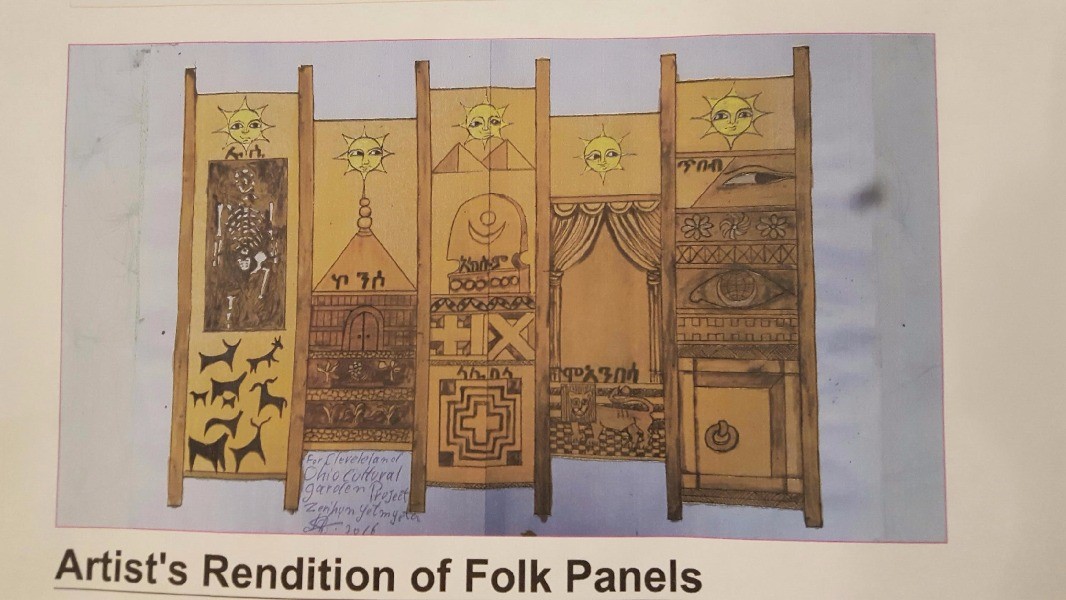
Phase 1 of our garden project, a ‘Grand Mosaic’ on both sides of a wall 12 x 18 ft., was envisioned, developed and completed by our Design Committee after six years of discussion, community planning and fund-raising, and in spite of  financial shortages.  The cost was higher than anticipated. But on August 24th, 2019, we had a wonderful Unveiling Ceremony. Among those present were Ethiopian Ambassador Fitsum Arega, Mayor Frank Jackson of Cleveland, and other dignitaries. Our guest of honor was Artist Professor Zerihun Yetmgeta of Addis Ababa University, who designed the Grand Mosaic and conceptualized the Stele Arch (to be Phase 2). Our Mosaicist, Ernesto Spinelli originally from Kulubi, Ethiopia, who fabricated the Mosaic from Zerihun’s paintings was present, and also Art Historian Dr. Ray Silverman from the University of Michigan, to introduce Artist Zerihun, his long-time friend, having introduced his art to America in the 1990’s. Interestingly, from that time, we already had Zerihun’s painting ‘Tarik’ (‘History’) – copy below – and had been referring to it for ideas, not realizing we would find him. Then, 25 years later, unexpectedly we found Professor Zerihun himself in Addis Ababa, happy to help with the project! In a traditional style, this Mosaic depicts six million years of the history of Ethiopia – ‘The Land of Origins’— from the dawn of humanity to globalization. It is the world’s only monument to Ethiopia’s remarkable history, unity, and diversity. Among the Cultural Gardens, it is a unique work of art.

MOSAIC CONTENT: 5 PANELS OF ETHIOPIA’S UNIQUE HISTORY and CONTRIBUTION TO INDEPENDENCE OF NATIONS

1. Cradle of humankind: Lucy (Dinknesh), 3.2 million years old, was the first significant hominid fossil find, in 1974 by paleoanthropologists from the Cleveland Museum of Natural History, which is adjacent to the Cultural Garden Park. However, older, even more astounding fossils, dating back six million years, have been found by teams under the Museum’s present Curator of Anatomy, Dr. Yohannes Haile Selassie.

Also depicted in this panel are ancient rock paintings from 4,000 year ago near Dire Dawe.

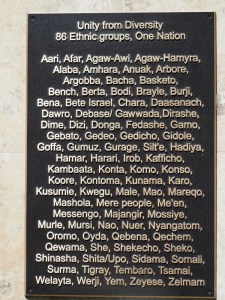
2. Diversification within Ethiopia of 86 ethnic groups and almost as many languages is exemplified by the Konso People as one representative of the many – a group from the South of Ethiopia who first initiated terraced farming several thousand years ago.

3. Ancient Civilizations, Religions of Ethiopia: Foremost is the Axumite Empire – 200 BC to 1000 AD—with builders of uniquely carved, monolithic stelae 79 feet tall. They became icons of Ethiopia with an enduring impact on art and architecture. Queen of Sheba’s son by King Solomon is said to have brought Judaism (known later as Be’te Israel) along with the Ark of the Covenant, per ‘Kibre Negest’ narrative, now said to be ensconced in a chapel in Axum. Christianity was proclaimed by Emperor Ezana in 330 A.D. In 615 A.D., early followers of Mohammad from Mecca were given asylum by the Axum Emperor, and Islam has become a major religion in Ethiopia. About 1200 A.D. Emperor Lalibela, in a town that now bears his name, carved 11 amazing monolithic Orthodox churches based on Axum Stelae designs. Then, also about 1200 AD, Harar, now in Ethiopia, became (and remains) one of the world’s most influential centers of Islam, at that time building 99 mosques, one for every name of Allah in the Koran. Most Be’te Israel emigrated to Israel in recent times. Christianity and Islam are the two main religions of Ethiopia today, being very compatible when outside influences are not factors.

4. Nation-Building, King of Kings, Independence – Rule by Emperors from Menelik I, legendary son of King Solomon and Queen of Sheba, to Haile Selassie. The Emperors, known as ‘King of Kings’, unified the nation and resisted European Imperialism, climaxing with the defeat of a large Italian army at the Battle of Adwa on March 1st, 1896, by Emperor Menelik II, Empress Taytu, and a remarkable coalition of patriotic regional rulers who put aside their differences and joined forces, surprising the Italians and defeating them, thus maintaining Ethiopian independence. This was a stunning defeat and a rallying cry for subjugated peoples around the globe, boosting morale, ethnic pride, and independence determinism. The empty throne in the mosaic indicates the interruption in 1974 of the ancient Solomonic Line of Emperors.

5. Globalization, depicted with a prominent ‘T’beb’ (Eye of Wisdom); also the proverb “Today’s flowers, tomorrow’s fruit”. The second eye is the ‘globe’ of globalization, with an encircling moon of technology. Finally is a message from Professor Zerihun on behalf of the imperative of Art, in the form of a symbolic doorway: the implied message: “We must keep knocking on the Door of the Visual Arts.”

MOSAIC SIDE 2: LOSS OF HABITAT, GLOBAL ENVIRONMENTAL CHANGE – THE UNTHINKABLE POSSIBILITY

The other side of the Mosaic Wall displays Professor Zerihun’s painting from 1987, “When the Sun Gets the Moon”, indicating destruction of forests (e.g. Ethiopian forest coverage once 60% is now less than 1%), and large polluted cities. We have made the Sun a destructive force in spite of technology that enabled travel to the Moon. Environmental decay, habitat loss, fossil fuels, other pollutants, yielding climate change, crop failures, extinctions, zoonotic diseases (SARS, Covid 19), population movements, hostilities, reactive leaderships, destructive military responses– all are intertwined. We have come to the unthinkable possibility of the collapse of civilization as we know it. Yet contrary to the connection of these events, logic fails and destructive policies continue. This painting is a plea, from the land where human life began, to redirect efforts, work together in peace, restore the environment. This was elegantly stated by Michael Higgins, President of Ireland, on his visit to Addis Ababa November 5, 2014, commemorated in a plaque on the mosaic:

“In the very long term, in the multi-secular temporal horizon which is that of Lucy, we are but immigrants in time and space – transient travelers who must do our best to pass on to the next generation a hospitable ground on which they can flourish.”

AMPLIFYING  GLOBAL  IMPACT: PHASES 2 AND 3

The Unveiling received good publicity here and in Ethiopia. Ambassador Fitsum Arega was impressed that this project was conceived and accomplished by our small Ethiopian community. The Mosaic is impressive, yet we need project completion for global impact: 1) historical pride, 2) support for national unity – democracy with diversity – and 3) a plea for worldwide cohesion & environmental restoration. It is desirable to build the next 2 Phases together: Phase 2, a 35 ft. tall stone arch, an   Axum Stele in Silhouette, and Phase 3, a stone replica of a Lalibela church doorway and patio in the shape of a map of Ethiopia. We have hopes for this Garden – a ‘Monument for the Ages’ – attracting worldwide attention and functioning as a unique gathering place. We are determined to complete Phases 2 and 3 as soon as possible.

For more including recent updates and to consider donating to complete phase II and III , visit the GoFundMe page created by Scott

http://www.gofundme.com/f/ethiopian-cultural-garden


Posted in Uncategorized | 1 Comment

“I want to come with you to the hospital,”

“I want to come with you to the hospital, see my stethoscope and mask, mommy got it for me”

That was the sweet sound of my soon to be 4 year old daughter waiting for me after a busy hospital call.
She was dressed in a doll white coat, a stethoscope on her neck and a matching face mask that mom got her on amazon.

She was seeing people with masks every time the TV was on. These days before she goes to sleep she prays “for daddy, mammy, and Mikel”, her younger brother.

This pandemic has caused so much worry, fear, anxiety, pressure , stress, the trauma of being isolated, inability to sleep well, concern about access to basic things like food, financial wellbeing and on and on ,irrespective of who we are , where we live, whatever is our status professionally or financially. Everyone is affected including the little ones. It is even more challenging for a health care provider as we juggle with the fear of being sick, infecting your loved ones or not be able to care for them.

Schools closed and many working remotely from home, many parents would struggle to protect and nurture kids through this pandemic.
Being creative and having a schedule to stick to would be helpful. Mom is using this time of home stay to teach the kids some Amharic.

We decided not to turn on the TV and avoid discussing about the pandemic in front of our children.

This past Sunday while celebrating Coptic Easter, we dressed them up with Ethiopian traditional dress and spend the time together eating Ethiopian food.

It paid off.

All day what she talked about was going to see her nephews and nieces in Ethiopia. It must have brought some memories from our last visit during the Ethiopian New year.

During this time of crisis we all have to step up and turn off the noise, try to relate and be concerned, and while doing all the appropriate things that public health practices recommend, we as parents and health care providers need to project a sense of pragmatic optimism be it at work in the front lines or when we get home paying special attention to the little ones who may not appreciate the facts but may feel unsettled when they see us anxious or worried.

Stay safe.

Posted in Memoir | 1 Comment

COVID-19 in Africa

The impact of COVID-19 in Africa is frightening. Africa already carries 23% of the global disease burden such as malaria, HIV, tuberculosis but only accounts for 1% of the global health expenditure. There are over 4300 confirmed infections with COVID-19 in Africa along with 117 recorded deaths but this may not reflect the true picture due to the wide spread lack of testing in Africa. There are over 650,000 cases globally including over 30,000 deaths and it is increasing rapidly.

The impact in Africa will be devastating unless something is done urgently which is acknowledged by many global leaders including UN Secretary General Antonio Guterres,

“Africa is in urgent need of tests kits, masks, and ventilators, protective suits for health workers…we can still prevent the worst in Africa but without a massive mobilization we will have millions and millions of people contaminated which means millions of deaths”, as reported by RFI.

Some facts about COVID-19
There is currently no vaccine or proven treatment for COVID-19 although there are ongoing trials and encouraging results driven from small clinical data sets prompting use of some medications for compassionate use.

PREVENTION, PREVENTION, PREVENTION
Wash your hands with soap and water for at least 20 seconds or use a hand sanitizer that contains at least 60% alcohol.
Avoid touching your eyes, nose and mouth with unwashed hands
Avoid close contact with people who are sick
Cover your mouth and nose with a tissue when you cough or sneeze or use the inside of your elbow; trash used tissue in trash; then wash your hands or use hand sanitizer as stated above.

Symptoms of COVID 19 that may appear 2-14 days after exposure:
FEVER
COUGH
SHORTNESS OF BREATH

Emergency warning signs to get medical attention immediately
TROUBLE BREATHING
PERSISTENT PAIN OR PRESSURE IN THE CHEST
NEW CONFUSION OR INABILITY TO AROUSE
BLUISH LIPS OR FACE
And consult your medical provider for any other symptoms that are severe or concerning.

The 2019 Nobel Peace Prize laureate Ethiopian PM Abiy Ahmed has stressed that only global victory can bring the COVID-19 pandemic to an end on an op-ed published on Financial Times on March 25. He called for a global leadership,
“Without that, Africa may suffer the worst, yet it will not be the last. We are all in this together, and we must work together to the end.”

We all have a moral responsibility to contribute in any way we can to defeat COVID-19.

Source
CDC.gov
Radio France International
FT.com

Posted in Current events, Health | Leave a comment

“Safe Abortion,” but safe to whom ?

Solomie Deribessa , M.D., MPH.

It was a beautiful Friday afternoon in 2005, after finishing my usual daily activity, I took a taxi to go home. Along the way I was reading a small booklet about the facts of abortion. The booklet was prepared by a group of physicians to oppose the imminent abortion law in the country at that time. Not knowing that this could affect the young lady who was sitting beside me, I continued to the 3rd and 4th pages; some of the pages in the booklet contained disturbing pictures and I tried to cover those with my hand, but the lady was attentively following what I was reading and she requested to uncover it, and I did .

She was in her mid-twenties. She started to cry; I was shocked and got also confused … and asked for apology. However, she said “You don’t need to apologize,” she continued “Today I have learned the biggest lesson in my life.”
She asked if I could spend some minutes with her. I was already eager as to what connection the lady could have with the pictures, and I agreed, and we both got off the taxi and went to a nearby small cafe. She started by introducing herself to me,

“My name is Zinet (not her real name), I came recently from a neighboring country where I had been working as a house maid for the last two years. I always disliked the way the house master looked at me. One day when I was doing my house cleaning duty, he just got into the room and closed the door, I tried to shout, but no one was in the house… and he raped me. My spirit was broken. His wife did not know what happened, but she noticed that I was depressed and I could not be the playful girl that she knew before. Besides the psychological trauma I faced; after few weeks I found out that I was pregnant. I had a lot of awful mixed emotions however decided to make some more money for my travel and stayed for four more months there and came back a week ago. My family is very conservative, and I have not told them yet, I don’t know what will be their reaction to my situation.”

She started wiping her tears from her face.

“Today I went to the hospital, I told them my problem and requested for abortion care. They gave me these laboratory papers to have blood and urine tests and they told me to come back with the results on Monday for the procedure.” Sobbing she continued.

“But why didn’t they tell me that abortion is killing a baby?” she cried pointing to the pictures on the booklet. I couldn’t answer on their behalf so I kept quiet again. I realized however that the pictures had a profound effect on her. “Thank you for saving me from shedding innocent blood.” I tried to comfort her and support her decision.

Throughout my conversation with her, my mind kept wandering, with so many questions; is it’safe’ as they call it? Safe to whom? Is ‘safe abortion’ the solution to ‘unsafe abortion’? Isn’t maternal safety comes at the cost of the baby’s life? Isn’t there other mechanisms to keep both safe? As health care providers, shouldn’t our mission be to save both lives? Why are the people who made the law so blind? Why doesn’t the government do the right thing? Who should advocate for the unborn baby? My mind whirled trying to find answers to these questions.

“You know what,” she said, “I will never, ever want to abort.” I was overjoyed with her decision and wanted to make some effort to help her. I called some friends who owned a private clinic; they provide free delivery service for needy women like her so I connected her to them.

After a few months, her friend called and told me that she gave birth to a beautiful 3 kg baby girl and she named her after me. Now her daughter has grown, all her family problems have been solved and she is a happy mother.
She has never regretted allowing her daughter to live.

My encounter with Zenit created the ethical question of the so called “safe abortion” but safe to whom?
It remained instilled in my mind for several years.

Dr Solomie Deribessa is a pediatric infectious disease fellow at the Addis Ababa University in Addis Ababa, Ethiopia.

Posted in Opinion, Uncategorized | Leave a comment

Ethiopian PM Abiy Ahmed Wins the Nobel Prize!

“Abiy Ahmed has initiated important reforms that give many citizens hope for a better life and a brighter future,” the Norwegian Nobel Committee.

Congratulations!

Congratulations!

Congratulations!

This is a moment to cherish.

Posted in Current events, Uncategorized | Leave a comment

A piece of my practice : you cannot shake my hands!

Solomie Deribessa, MD, MPH

After the morning report, patients’ charts had piled up on my desk and the nurse started calling one by one.
The first patient came just to refill drugs, the second one had common cold, the third had skin infections but then comes Abiti.

Abiti was my fourth patient. He was brought to the clinic by his aunt who wore prosthetic appearing shoes. I stretched my hands as I would greet all my patients but she held back.

I was caught by surprise and again stretched my hands.

She burst in to tears. I was shocked and went around the table to comfort her. Her eyes welled with tears, she wrapped her hands with neṭela (ነጠላ) which is a handmade scarf-like cloth made of cotton. I shook her wrapped hand and I tried to console her.

“You know Doctor” , she said and continued, “HIV , Leprosy and poverty are deadly combinations . Though I am walking, I feel like I am a dead person. It has been several years since I became diabled like this because of Leprosy,” she paused to wipe her tears.

“Two decades have passed since I received a hand shake from people.”

I asked her why?

“Because people think that they may get Leprosy if they touch my hands or body but the worst of all is they think I have HIV. After I lost my brother and his wife because of AIDS, I brought his two sons to live with me , both of them are HIV positive but we didn’t know until later after my husband died. When the neighbors knew that I am taking care of kids with the virus and later after my husband died of HIV, they completely shut me off; they are not even talking to me. “

Back in 2007 the stigma towards people living with HIV had been immense, that was the time that people used to expel HIV positive people renting their houses and were closing their doors for HIV positive neighbors. The stigma is still strong in Africa and many parts of the developing countries. In Western societies and among educated people in many major cities in Africa, HIV is just another chronic illness and millions are living with the virus taking their anti-viral medications.
She continued her story,

“On top of everything I became a widow; my husband died a year ago of HIV/AIDS.”

Looking at my perplexed face, she quickly followed,

“The death of my husband was my fault”.

She said her husband was bed ridden because of leprosy. They had meager resources and barely had anything in the house. They shared needles and blades to shave; didn’t have money to buy extra. They didn’t know then that the boys had HIV.

I felt terribly sorry and wanted to cry. I asked her if she has been screened for HIV and she said she had never been tested. After a brief counseling I asked her if she was willing. She agreed but also added that she is a dead woman walking.

One hour after we took the test, all of us in the clinic sighed with relief. She tested negative for HIV. We overjoyed to tell her the result and we called her to the private counseling room to announce the good news. She was somewhat relieved but she still has to take care of Abiti and his brother … and the stigma…of both HIV and leprosy… and the challenges of deep poverty.

They left the clinic reassured that I won’t abandon them like their neighbors.

(This is based on a true story, actual names are not used)

Dr Solomie Deribessa is an experienced pediatrician who is a pediatric infectious disease fellow at the Addis Ababa University in Addis Ababa, Ethiopia.

Posted in Memoir | 2 Comments

Saving Ethiopia

April 2, ….

I, my wife, our 9 year old daughter and 7 year old boy are taking off the Ethiopian after a 13 hour flight from Washington DC. For our children this was their most important trip. They were 1 and 3 year olds when we first visited Addis together.
It was a comfy flight but our daughter kept asking nonstop questions about Ethiopia and most of which were directed to me.
I was dozing off when she said,
‘Daddy, I am excited to see Ethiopia
I am excited to see my nephews and nieces
Grand ma and dad.
But do you know who I am excited to see the most? ‘
She got me curious.

‘The riverside in Addis. I want to go to the park. Would you drive us from Entoto to Akakai ?’

Of course we will see that.

I reassured her. I wanted to see it myself. When the prime minister proposed his “The Beatifying Sheger ” project within few months of coming to power, I though it will just be a dream and won’t be completed. It was a billion birr project. He pulled it off. We heard it has become a tourist attraction and no wonder my daughter has seen the video on YouTube.

‘Daddy, what does Sheger mean ?’

It is another name for Addis.

Does Addis has other names other than Sheger ?

Finfine in Oromigna

‘Daddy, why do you only teach us Amharic, we want to know Oromigna ,Tigrigna, Guragigna.’

I would love you both to learn Oromigna. It is a beautiful language but I missed the opportunity to learn it well when I was at a medical school in Jimma.

She was visibly upset that we didn’t make effort to learn major Ethiopian languages and yet we are fluent in English and try to learn Spanish.

Our boy finished the inflight entertainment Ethiopian move that caught his attention and joined our conversation. My wife is trying to sleep and nudged me to keep our voice down. An elderly woman on the flight who was sitting just behind us peeked her head and asked if the kids have seen Awassa.

‘No they haven’t. They were kids last time we visited Ethiopia and it was not safe to visit Awassa.

‘Everything is peaceful now.’ She said loudly and continued.
‘The whole country is peaceful now. The first two years was difficult for the prime minister but he made bold decisions and sailed the ship despite the turbulence.’

“It was not the prime minister alone. It is Team Lemma.” That was from the passenger next to her.

All were visibly happy.

Soon, the flight attendants started getting us some snacks. The children were nicely distracted. I used the moment to take a nap.

‘Dadda, daddy, what is it that the prime minister did that made the country peaceful? ‘

That is a good question I said to my boy and tried to explain to him. In 2018 and 2019 the country was in a difficult transition. It was almost slipping in to an ethnic based civil war like Rwanda. You guys were kids but we were all concerned and tuned ourselves to daily news outlets. Especially your mother was busy listening to the Ethiopian Television, ESAT, OMN, Zehabesha, and many other news outlets including the print media. The country’s elites were fighting an ideological war. Unlike today the country was divided among 8 ethnic based regions and one multi ethnic region, southern people and nationalities. There were elites who believed that ethnic and language based regional divisions was better for Ethiopia given its many ethnic nature and historic grievances while others felt that it would be difficult to build modern democracy in an ethnic based administrative divisions and that can lead to ethnic conflicts. The latter group mention Kenya as an example. Kenya is also multi ethnic multi linguistic society but the political parties were not based on ethnic groups. At the time Kenya was also ahead of us in terms of democracy even if they also had their short comings.

‘Daddy, what is our ethnic group?’ Asked my daughter.

We are mixed. Between me and your mother we have every major ethnic group so we call ourselves of Ethiopian decent. All your aunts and uncles are also intermarried. I want to tell you both however that it is now illegal to ask one’s ethnicity so be careful; don’t get us in trouble.

‘Like Rwanda ?’

Yes like Rwanda. Thanks to the Prime Minister who followed the footsteps of Rwanda to ban it but took many years to implement it. Ethnic identity was embedded in every civilian discourse for three decades in Ethiopia.

My wife was upset that I have engaged our children in heavy political languages that they barely understood. I wasn’t only talking to them. The couple who sat in front of us had joined the discussion when I mentioned Kenya. They were both from Kenya and were curious.

The flight attendants started picking up trash and interrupted our discussion for a moment.

I continued. At first the prime minister appeared undecided but when I look back he was just getting everyone come along with him. He was ahead of everyone and had to wait for others to catch up. He had many challenges and resistance from the very same party he was elected to lead. He was not alone. There were many journalists and scholars who warned about the impending ethnic conflict and its tragic consequences. I remember grand ma how worried she was and like many mothers kept praying.

‘Daddy, why do you say prime minister? Isn’t he a president?’

Well, he was a prime minister then. He unified his party in to a multi-national one and minimized the role of ethnic based parties. He convinced the major players to change the constitution to a presidential system and won handily.

‘Like the USA?’

Yes like the USA.

“I wish he banned ethnic based parties”, said the lady behind us.

It is democracy. I said. The country can’t close its doors to any opinion but as long as the majority are not coerced to follow those opinions.

The Kenyan woman followed when I paused.

“You guys are lucky. The youngest prime minister in Africa has made a tremendous contribution to the whole Africa. In the past 6-7 years since he came to power, he has made progress in integrating the horn of Africa, pushed Eritrea to democracy, South Sudan is at peace with itself, has helped the democratic transition in Sudan, and has created a win –win situation with Egypt. The completion of the hydroelectric power on the Nile has lit the whole region.”

The kids have slept once they realize that the adults are taking the conversation seriously.

Are you guys transiting or going to visit Addis?

“We are headed to watch the African Nations cup. Kenya is in group D along with Gabon and Burundi. They are playing in Lekemte stadium, Wolega region. The group stage is played in many cities including Jijiga, Awassa, Jimma, Metu… The quarter final is in Mekele. The semifinal is in Bahir Dar. Addis is hosting the final.”

I had no idea that the country was selected to host the cup.
Where will you be staying?

“It is a five star hotel. It is only a short drive from the stadium.”

I couldn’t wait to check it out. It will only be a short flight from Addis; a weekend trip.

The captain was overhead announcing the final decent.
The landing was smooth.

A sign welcomed us to the new mega million international airport in Bishoftu!

We picked up our luggage and took a high speed train to the city of Addis, Sheger, Finfine as they all used interchangeably and affectionately. We checked in our condo that we still paying for using diaspora financing initiative the country introduced at the new luxurious La Gare multi-complex development next to my childhood home, Sengatera.

The country has become one!

Daddy, daddy , daddy , wake up it is the roosters crowing.

April 3, 2025!

Posted in Opinion | 3 Comments